The most comprehensive assessment of global peace ever published paints a sobering picture—but also points toward solutions
In a world where conflict deaths have reached their highest level in 25 years and over 120 million people have been forcibly displaced from their homes, the need for clear-eyed analysis has never been more urgent. The inaugural Annual GPA Peace Index 2025, published this month by the Global Peace Alliance Research Institute, delivers exactly that—a comprehensive, data-driven assessment that should serve as both warning and roadmap for anyone concerned about humanity’s collective future.
What Makes This Index Different
Unlike existing peace indices that focus primarily on measuring violence, the GPA Peace Index employs a groundbreaking multidimensional framework that assesses both “negative peace” (the absence of violence) and “positive peace” (the presence of structures that create peaceful societies). Perhaps most significantly, it integrates emerging threat vectors that traditional frameworks underweight: cyber warfare, the climate-conflict nexus, and AI-enabled violence.
The report synthesizes data from dozens of authoritative sources—from the Uppsala Conflict Data Program to UNHCR displacement statistics to public opinion surveys—creating what may be the most comprehensive snapshot of global peace ever assembled. It ranks 163 countries, identifies emerging threats, highlights success stories, and provides concrete policy recommendations.
Five Alarm Bells
The index’s headline findings should concern anyone paying attention to global affairs:
1. Peace Agreements Have Collapsed
Only 43 peace agreements were signed in 2024—the lowest in a quarter century. For the second consecutive year, not a single comprehensive interstate or intrastate peace agreement was reached. This represents a fundamental failure of traditional conflict resolution mechanisms.
2. Cyber and Physical Warfare Are Merging
The report documents over 430 nationally significant cyberattacks in 2024, a 300% increase from 2023. More alarming still is the emergence of “cyber-kinetic convergence,” where digital reconnaissance directly enables physical military strikes—a new form of warfare being pioneered in Ukraine and elsewhere.
3. Displacement Has Reached Crisis Levels
Global forced displacement exceeded 120 million people—equivalent to the entire population of Japan. Conflicts in Sudan, Gaza, Ukraine, and Myanmar are primary drivers, but climate-related displacement is emerging as a parallel crisis that will only intensify.
4. Military Spending Hits Record Highs
Global military expenditure exceeded $2.4 trillion in 2024, representing the highest level of militarization in two decades. Meanwhile, conflict prevention receives less than 1% of this investment—a catastrophic misallocation of resources.
5. International Institutions Are Paralyzed
The UN Security Council’s inability to address conflicts in Gaza, Ukraine, and Sudan demonstrates the fatal weakness of veto-based decision-making. The current peace architecture, designed for the bipolar world of 1945, cannot handle today’s multipolar, interconnected conflicts.
Beyond the Darkness: Signs of Hope
Yet the report isn’t purely pessimistic. It identifies genuine success stories that offer blueprints for what works:
Colombia’s “Total Peace” process achieved 23 peace agreements in 2024 with various armed groups—more progress than most countries see in decades. The report attributes this to sustained government commitment, inclusive dialogue, local empowerment, and consistent international support.
The Saudi-Iran détente, brokered by China in March 2023, has reduced proxy warfare intensity across Yemen, Lebanon, and Iraq. It demonstrates that even bitter adversaries can achieve meaningful de-escalation when mutual exhaustion creates new incentives.
Local peace initiatives in communities across Yemen, South Sudan, and Papua New Guinea show grassroots efficacy that international interventions often lack. When empowered with authority and resources, communities can effectively resolve their own conflicts.
Perhaps most encouraging: global public opinion is far ahead of governments on peace cooperation. The report’s polling analysis reveals that 68% of people worldwide prefer diplomacy over military force, and 61% support creating a dedicated international peace organization—even as their governments remain locked in zero-sum competition.
The Climate-Conflict Connection
One of the report’s most valuable contributions is its systematic documentation of how climate change is actively driving conflicts today—not in some distant future. Water scarcity in the Nile, Tigris-Euphrates, and Indus basins is generating interstate tensions that could explode into war. The Sahel’s desertification has displaced pastoralists southward, igniting ethnic conflicts often misunderstood as purely political or religious.
The statistics are stark: countries with high climate vulnerability are 3.5 times more likely to experience armed conflict. For every 1°C temperature increase, interpersonal violence rises 4% and intergroup conflict rises 14%. Twelve of the twenty most water-stressed countries have active conflicts or severe instability. As the report bluntly states: “By 2030, an estimated 143 million people will be displaced by climate change. Conflict prevention must integrate climate adaptation, or humanitarian interventions will perpetually respond to symptoms while root causes intensify.”
Regional Realities
The report’s regional analysis reveals how profoundly peace and conflict patterns vary across the globe:
Africa faces a crisis of state capacity, with the Sahel coup belt (Mali, Burkina Faso, Niger) showing how military takeovers can create contagion. Sudan’s civil war has generated the world’s fastest-growing displacement crisis—8 million people uprooted in 18 months—yet receives only 27% of required humanitarian funding because no major power has strategic interests there.
The Middle East remains the world’s most conflict-intensive region, with the Gaza war triggering the worst humanitarian catastrophe since Syria’s civil war peak. Yet paradoxically, the region also produced the most significant diplomatic breakthrough: the Saudi-Iran normalization.
Europe is experiencing its largest conventional war since 1945, shattering post-Cold War assumptions about permanent peace on the continent. Ukraine demonstrates both the horror of great power aggression and the limits of international response.
Asia-Pacific faces the world’s most dangerous paradox: deep economic interdependence coexisting with severe security competition. The Taiwan question represents the highest risk of great power war globally, with implications far beyond the region.
The Case for New Architecture
Perhaps the report’s most important contribution is its systematic case for reforming global peace infrastructure. The accumulated evidence across hundreds of pages builds to an unavoidable conclusion: current institutions cannot handle today’s conflicts.
The UN Security Council remains paralyzed by great power vetoes—Russia has vetoed 18 resolutions on Syria, the U.S. has blocked action on Gaza, and Sudan receives no meaningful UNSC attention because Russia protects Wagner operations there. Regional organizations often lack resources or political will. Bilateral diplomacy remains fragmented and episodic. Early warning systems identify risks but trigger no systematic preventive action.
The report argues that a Global Peace Alliance—with guaranteed funding, unified mediation, rapid deployment capabilities, weighted (non-veto) voting, and explicit prevention mandates—could address these failures systematically. It’s a bold proposal, but one grounded in empirical evidence about what actually prevents wars: early engagement, addressing root causes, inclusive processes, adequate funding, and credible enforcement.
Critical Cases to Watch
The report includes a conflict early warning dashboard identifying situations at elevated escalation risk:
Critical Risk: Taiwan Strait (highest risk of major power war globally), Iran’s nuclear program and regional tensions, and Haiti’s complete state failure.
High Risk: Ethiopia’s internal conflicts, Pakistan’s state fragility, Venezuela’s implosion, Kosovo-Serbia tensions, and Sahel jihadist expansion.
The case studies are particularly illuminating. The report examines Colombia’s peace success, Sudan’s preventable catastrophe, and Gaza as a missed prevention opportunity where warning signs were systematically ignored until October 7, 2023 shattered all assumptions.
The Generational Divide
One of the report’s most striking findings concerns age differences in attitudes toward peace. Younger generations (18-29) are significantly more supportive of international cooperation than older cohorts:
- 72% of youth support supranational peace enforcement vs. 42% of those 65+
- 77% prefer diplomacy over military force vs. 58% of older generations
- 64% willing to cede some sovereignty for effective peace vs. 34% of those 65+
This suggests that future political leadership will be more receptive to supranational approaches—if institutions can demonstrate effectiveness. As the report notes, young people “having grown up in era of ‘forever wars’ that achieved little at high cost, are more skeptical of unilateral military action but MORE supportive of international cooperation.”
Why This Matters Now
The world stands at what the report calls “a historic inflection point.” Current conflicts show no clear path to resolution. Climate change will accelerate resource conflicts. Cyber warfare is normalizing daily hostilities between major powers. Nuclear proliferation risks are at their highest since the 1960s. The humanitarian system, designed for temporary Cold War-era crises, cannot handle permanent mass displacement.
Yet as the report emphasizes, sustainable peace remains achievable. Human societies have demonstrated remarkable capacity for cooperation and institution-building when circumstances demand it. The UN itself was born from World War II’s ashes. The European Union emerged from Europe’s fratricidal conflicts. Today’s interconnected threats—climate change, pandemics, cyber risks, displacement—inherently require collective responses transcending borders.
The fundamental question is whether we reform peace architecture proactively and deliberately, or wait for an even greater catastrophe to force reactive change.
Read the Full Report
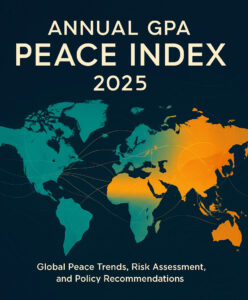 This article barely scratches the surface of the Annual GPA Peace Index 2025’s 60+ pages of data, analysis, and recommendations. The complete report includes detailed country profiles, regional maps, public opinion analysis, case studies, and comprehensive policy recommendations for the UN, regional organizations, and individual nations.
Most importantly, it establishes an empirical baseline against which future progress—or continuing deterioration—can be rigorously measured. As the report states in its conclusion: “Peace remains possible. Human societies have demonstrated remarkable capacity for cooperation, reconciliation, and institution-building when existential circumstances demand it. But sustainable peace requires institutions explicitly designed for peace as their primary mission.”
Download the full Annual GPA Peace Index 2025 here: https://shorturl.at/xYhpB
Whether you’re a policymaker, student, journalist, activist, or simply a concerned citizen, this report deserves your attention. The data is clear. The path forward is visible. What remains is political will—and that begins with awareness.
The first step toward solving any problem is understanding it. The GPA Peace Index provides that understanding with unprecedented depth and clarity. What we do with that knowledge is up to us.
The Annual GPA Peace Index 2025 was published by the Global Peace Alliance Research Institute in November 2025. Future editions will be published annually to track progress on global peace trends.
#GlobalPeace #PeaceIndex #GPA2025 #InternationalRelations #ConflictResolution #Peacebuilding #GlobalSecurity #Diplomacy #ForcedDisplacement #RefugeeCrisis #ClimateConflict #CyberSecurity #UnitedNations #Geopolitics #ForeignPolicy #InternationalDevelopment #HumanRights #SustainablePeace #GlobalGovernance #PeaceAndSecurity